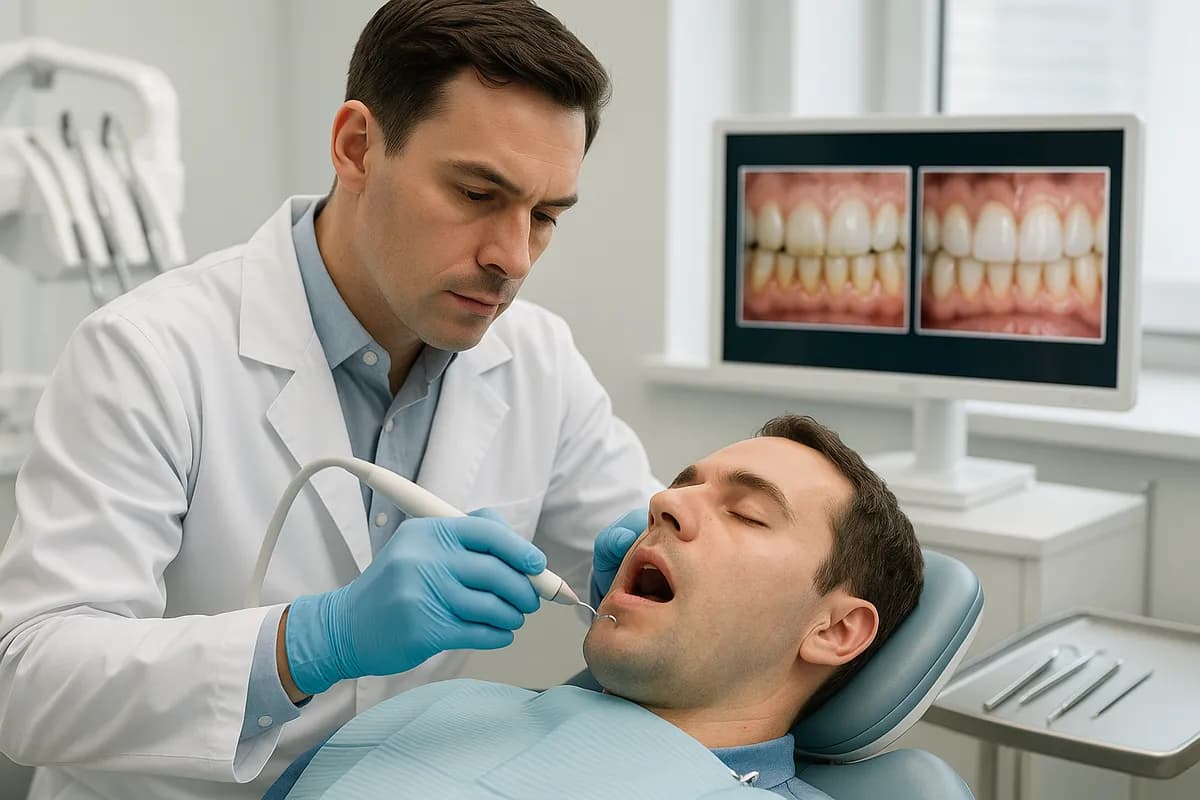
Why Not Every "Dental Scaling" Session Is High Quality? Tips Only Specialists Know
Dental scaling isn't just a routine procedure — the method matters! In this article, discover the techniques and insights known only to periodontal specialists, who can perform effective and complication-free scaling.
Why Is Not Every Teeth Scaling Procedure High Quality? Expert Tips Only Specialists Know
Teeth scaling may appear to be a simple procedure, but its quality completely depends on the dentist’s skill, the equipment used, the technique applied, and an accurate evaluation of the patient’s teeth and gum condition.
Poor-quality scaling does not only mean that the tartar is not completely removed; it can also lead to:
Tooth sensitivity.
Gum inflammation.
Bad breath.
Rapid return of tartar buildup.
Below are the most important points that specialists pay attention to when performing professional teeth cleaning:
1. Identifying the Type of Tartar and Choosing the Right Instruments
Not all tartar is the same.
There are two main types:
Supra-gingival tartar → located above the gum line on the tooth surface.
Sub-gingival tartar → located below the gum line and around the tooth roots.
Professional scaling means cleaning both areas with the appropriate instruments for each condition.
If only the visible tartar on the teeth is removed while the areas under the gums are not cleaned, the result may only be cosmetic while gum disease continues.
2. Measuring Gum Depth Before Scaling (Periodontal Charting)
Before starting the procedure, specialists evaluate:
Gum pocket depth.
The level of bone loss.
Areas affected by infection or inflammation.
If gum pockets are deep (for example, 4–6 mm), the patient may require:
Professional sub-gingival cleaning or Scaling and Root Planing (SRP).
In these cases, simple surface scaling is insufficient and ineffective.
3. The Right Device and Proper Tips for Each Area
In high-quality scaling, dentists use:
Thin tips designed for sub-gingival areas.
Stronger tips for removing hard tartar.
Properly adjusted power and frequency according to the condition.
Using the same universal tip for all teeth often results in incomplete cleaning.
4. Professional Polishing After Scaling
The importance of polishing is sometimes overlooked, but specialists know that it is an essential step because it:
Reduces the speed of new tartar attachment.
Smooths the tooth surface.
Helps decrease sensitivity after scaling.
Scaling without polishing = incomplete results.
5. Removing Bacterial Biofilm (Not Just Visible Tartar)
The main cause of gum inflammation is bacterial biofilm.
This layer cannot be seen with the naked eye and can only be removed effectively with proper techniques.
Scaling is not only about removing hardened deposits; the main goal is eliminating bacterial biofilm.
Poor-quality scaling may leave biofilm behind, causing gum inflammation to return within a few weeks.
6. Incorrect Device Power and Wrong Angulation
If the device power is too high:
Tooth roots may be affected.
Severe sensitivity may occur.
If the power is too low:
Hard tartar may remain.
Incorrect angulation of the scaling tip may also cause:
Scratches on the tooth surface.
Remaining tartar in small grooves and difficult areas.
These details are controlled by an experienced dental professional.
7. Scaling Should Include Proper Gum Irrigation
After scaling, some dentists may perform additional steps such as:
Rinsing gum pockets with antibacterial solutions.
Applying topical antibiotics (gel) in specific cases.
This step improves treatment quality and supports better gum healing.
8. Patient Education After Scaling
Even an excellent scaling procedure cannot provide complete results without proper patient education.
After professional cleaning, dentists should explain:
The appropriate toothbrush type.
The correct amount of toothpaste.
Proper brushing technique.
How to use dental floss and mouthwash.
This helps maintain the results and make them long-lasting.
Professional Summary
Not all scaling procedures have the same quality.
High-quality scaling means:
Accurate diagnosis.
Proper instruments and specialized tips.
Cleaning below the gum line.
Final polishing.
Removal of bacterial biofilm.
Following scientific principles of angle, pressure, and technique.
These details are what transform teeth cleaning from a simple superficial procedure into a professional and therapeutic treatment that protects the health of teeth and gums.
please Login to leave a comment
Add Your Comment
Reviews