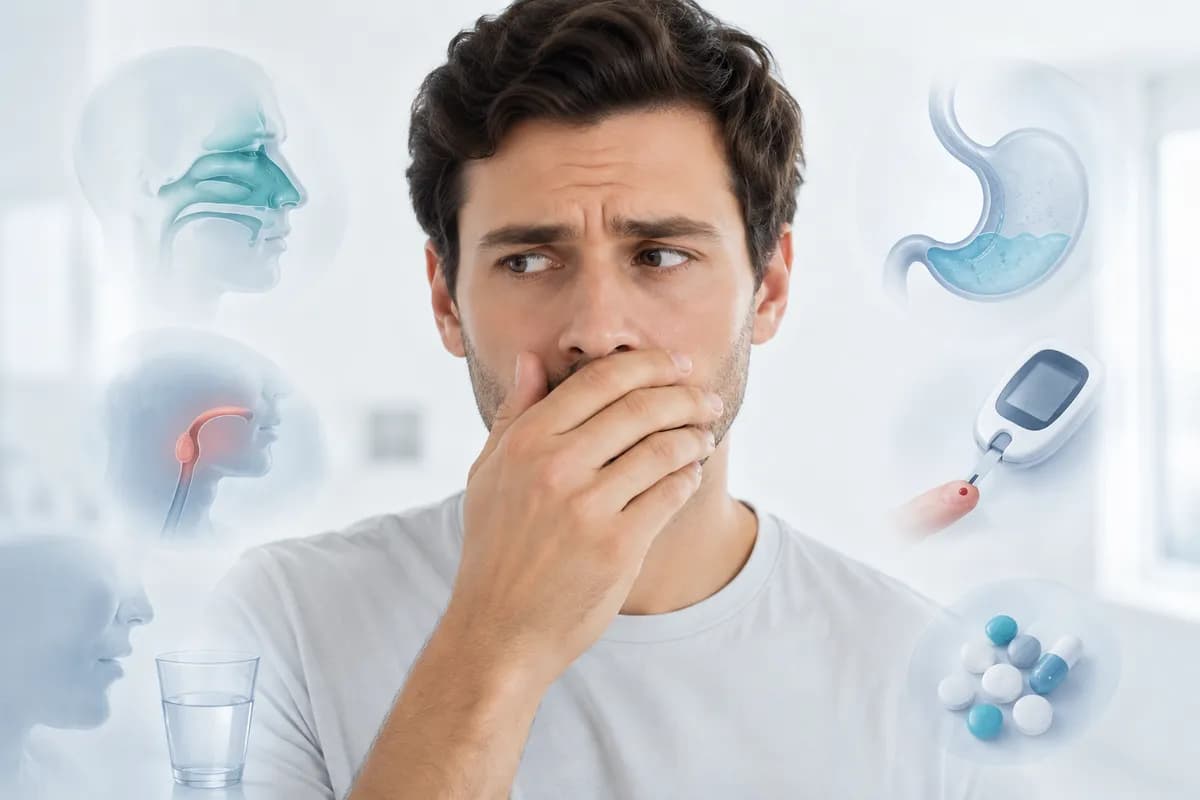
Bad breath — it might have nothing to do with your mouth at all!
Your bad breath might be coming from your stomach, sinuses, or even liver! Read this article to discover the non-dental causes of bad breath — before heading only to the dentist.
Bad Breath Is Not Always Caused by Teeth and Gums; Sometimes the Source Is the Body!
Bad breath is not always related to dental or gum problems. In fact, around 10 to 20% of cases do not originate from the mouth at all and are caused by problems inside the body.
These cases are often overlooked, and patients may spend months using tooth cleaning methods, professional scaling, and mouthwash, while the problem continues to remain.
Below are all the non-oral causes of bad breath explained in a scientific and easy-to-understand way:
1) Stomach Problems and Acid Reflux
These are among the most common non-oral causes of bad breath.
Acid reflux (GERD) → the backflow of stomach acid or food into the esophagus and mouth.
Helicobacter pylori (H. pylori) → a stomach bacteria that can cause strong odor and a bitter taste.
Delayed stomach emptying → incomplete digestion and fermentation of food.
Associated symptoms:
Heartburn.
Acidic taste in the mouth.
Bitter taste, especially in the morning.
2) Sinus Problems and Nasal Issues
In cases of sinusitis, postnasal drainage can cause persistent and especially morning bad breath.
Common causes include:
Chronic sinusitis.
Deviated nasal septum.
Severe allergies.
Pus-like drainage at the back of the throat.
The odor is often accompanied by thick mucus and an unpleasant taste.
3) Dry Mouth (Xerostomia)
It has been proven for years that dry mouth is one of the main causes of bad breath, even when the teeth are completely healthy.
Causes of dry mouth include:
Medications (antihistamines, antidepressants, blood pressure medications).
Stress and anxiety.
Dehydration.
Mouth breathing.
Diabetes.
Salivary gland disorders.
When saliva production decreases, bacteria become much more active and multiply rapidly.
4) Digestive and Liver Problems
Poor digestion and certain liver conditions can contribute to unpleasant breath odor.
Possible causes include:
Severe fatty liver disease.
Liver failure.
Intestinal fermentation.
Irritable bowel syndrome (IBS).
Small intestinal bacterial overgrowth (SIBO).
Associated symptoms:
Bloating.
Abdominal heaviness.
Bitter taste in the mouth.
Changes in bowel movements.
5) Uncontrolled Diabetes
One of the most recognized non-oral odors is:
A fruity or sweet smell, sometimes described as similar to chewing gum.
Caused by the production of ketones in the blood.
This type of odor does not disappear simply by brushing your teeth or using mouthwash.
6) Kidney Diseases
In kidney failure, the body cannot properly remove ammonia and nitrogen-based waste products.
The result:
A smell similar to fish or ammonia.
This type of odor can be an important medical warning sign and requires evaluation.
7) Tonsil Problems and Tonsil Stones
Tonsil stones are small white deposits that form inside the tonsils and can produce a very unpleasant odor.
Symptoms include:
Severe bad breath despite excellent oral hygiene.
Feeling like something is stuck in the throat.
Small white spots on the tonsils.
This condition is very common but often underdiagnosed.
8) Strict Diets or Long-Term Fasting
When the body enters a state of starvation, it begins a process called ketosis, where ketones are produced and released through breathing.
The resulting odor may be:
Strong.
Slightly sweet.
Similar to nail polish remover.
9) Hormonal Changes
Especially in women:
Menstrual period.
Pregnancy.
Menopause.
Hormonal fluctuations can affect saliva production and change the balance of bacteria in the mouth.
10) Certain Medications
Some medications reduce saliva production or produce compounds with unpleasant odors, including:
Antidepressants.
Blood pressure medications.
Antihistamines.
Chemotherapy drugs.
Some vitamins and dietary supplements.
Conclusion
If the teeth, gums, and mouth are healthy but bad breath continues, the cause may be related to one of the following:
Stomach problems or acid reflux.
Sinus problems.
Dry mouth.
Diabetes.
Intestinal problems.
Liver conditions.
Tonsil problems.
Certain medications.
Strict diets or prolonged fasting.
In these situations, maintaining oral hygiene alone may not be enough. The underlying cause should be identified and properly treated.
please Login to leave a comment
Add Your Comment
Reviews